
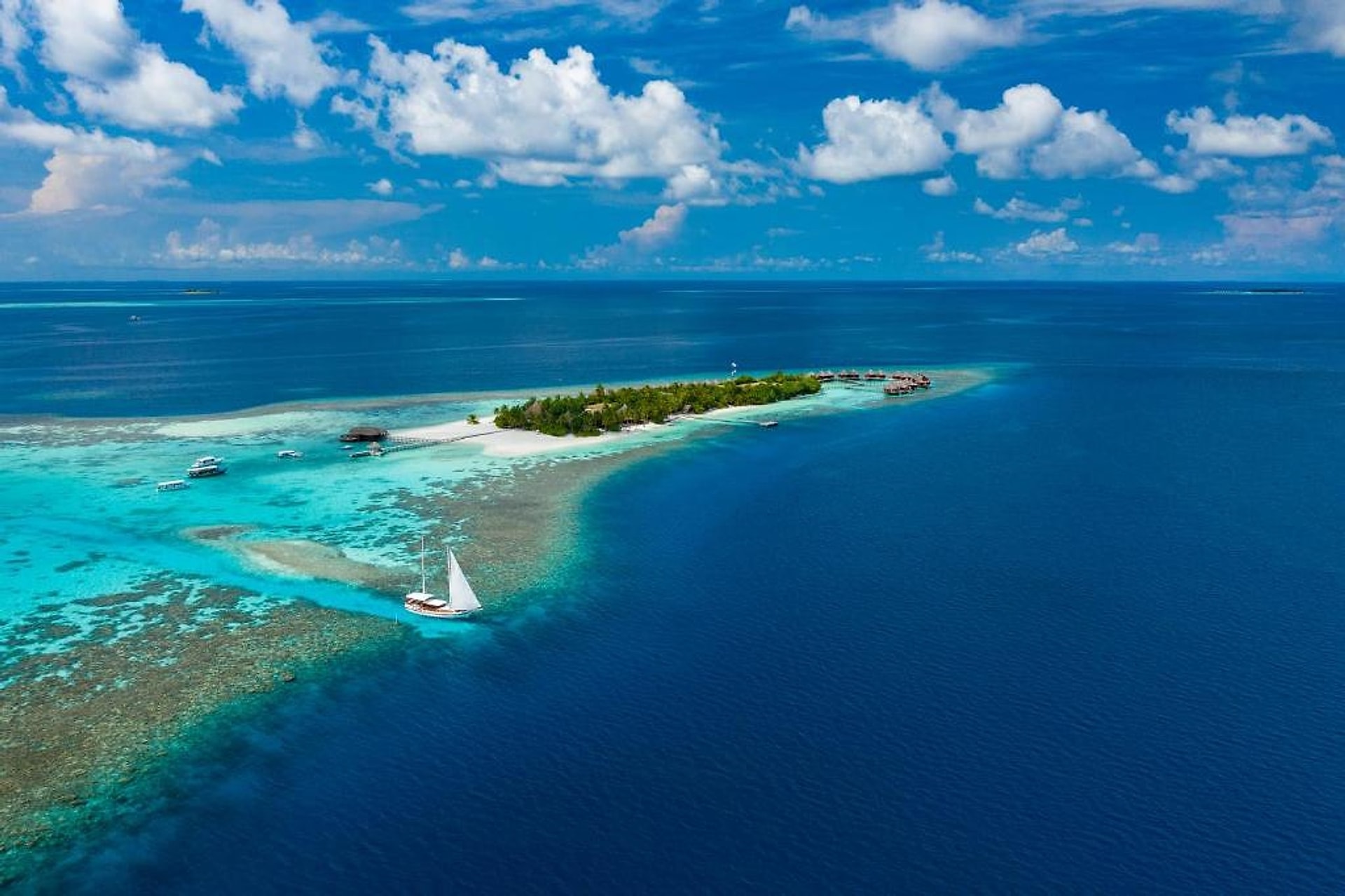
A week in the Maldives costs roughly $1,500 per person on a guesthouse budget, $5,000 per person for a mid-range resort or overwater bungalow, and $15,000 or more for a top-tier villa resort with a seaplane transfer, as of August 2026. The gap between those figures is not marketing spin — it comes down to three line items: where you sleep, how you get to the island, and whether meals and excursions are included. Guesthouses on local islands run $40–$120 a night and use $100–$250 speedboat transfers, while resort villas start around $300 and climb past $1,500 a night, often requiring a $350–$650 seaplane return. Guesthouses are now the fastest-growing segment of Maldives tourism, at roughly 26% of all arrivals, precisely because they make a real Maldives trip possible on a modest budget without cutting the trip short — the average visitor stay is about 7 days either way.
Below are three real, itemised budgets built around a 7-day trip for one traveller, followed by the transfer, season and excursion costs that swing the total the most.
What does a $1,500 Maldives trip look like?
A $1,500 budget means staying on an inhabited local island rather than a private resort island, and it is entirely realistic for a full week. Guesthouses on islands like Maafushi, Fuvahmulah, Thinadhoo or Hulhudhoo charge $40–$120 a night, so seven nights runs $280–$840. Add a $100–$250 round-trip speedboat transfer from Velana International Airport, $25–$40 a day for meals eaten at local cafés rather than resort restaurants, and one or two excursions — a $80–$150 whale shark trip or a snorkelling tour — and the total lands comfortably under $1,500 including the visa-free entry fee (Maldives issues visas on arrival for most nationalities). This is also the segment where the numbers back up the value: guesthouses are the fastest-growing part of Maldives tourism at around 26% of arrivals, and our guide to the Maldives on any budget breaks down exactly how far this stretches. For a shortlist of vetted properties, our roundup of the top guesthouses in Maafushi is the best starting point, and Maafushi itself sits inside the wider network of inhabited local islands now open to tourists.
What does a $5,000 Maldives trip look like?
At $5,000 per person for seven nights, you are looking at a mid-range resort room or a nicer overwater bungalow, generally $300–$700 a night depending on the atoll and season. That is $2,100–$4,900 for accommodation alone, leaving room for a $250–$450 speedboat transfer (most mid-range resorts sit within speedboat range of the airport, avoiding the seaplane premium), half-board or all-inclusive meals, and two or three excursions such as a sandbank picnic, a dive trip, or a manta ray snorkel during manta season (May–November) at Hanifaru Bay in Baa Atoll. This tier is also where all-inclusive resort packages start to make sense financially, since bundling food and drink can save $50–$100 a day versus paying à la carte. Choosing an atoll closer to Malé — North Malé or South Malé rather than Baa or Addu — is the single biggest lever for keeping this budget under control, since it removes the seaplane cost entirely.
What does a $15,000 Maldives trip look like?
At $15,000 and above, you are in five-star villa territory: private-pool overwater villas or beachfront residences at $1,000–$1,500+ a night, a $350–$650 seaplane return, all-inclusive or premium dining plans, and private excursions like a sunset cruise or a guided dive at a signature site. Seven nights at $1,200 a night alone is $8,400, and once you add the seaplane transfer, spa treatments, and a private dining experience or two, $15,000 per person is a realistic ceiling rather than an exaggeration — some of the newest openings sit well above it. Several forthcoming properties will sit squarely in this bracket, including Bulgari Ranfushi, Rosewood Ranfaru, Mandarin Oriental Bolidhuffaru and Atlantis The Royal, alongside established ultra-luxury names; Velaa Private Island was recently named among the world's top ultra-luxury private islands, which gives a sense of where this tier's benchmark sits. Travellers arriving by charter or private yacht are a fast-growing part of this segment too, a trend covered in our piece on super yacht tourism in the Maldives.
How does the atoll and season change the total?
Two variables move every budget tier by hundreds to thousands of dollars: which atoll you choose and when you travel. Resorts in North and South Malé Atoll are reachable by speedboat, saving the $350–$650 seaplane fee that outer atolls like Baa, Addu or Laamu require. Season matters just as much — December through April is the dry season and the peak-demand period, when resort rates rise across the board, while the shoulder months either side often bring lower rates without materially worse weather. Surfers should note that surf season runs April–October, concentrated in atolls with wave breaks, while May–November is manta and whale shark season around Hanifaru Bay. Full seasonal guidance, including which months balance cost against weather, is in our best time to visit the Maldives guide, and the practicalities of hopping between islands and atolls are covered in getting around the Maldives.
How do the three budgets compare side by side?
Budget | Accommodation (7 nights) | Transfer (return) | Meals/day | Excursions | Total (per person) |
|---|---|---|---|---|---|
$1,500 trip | Guesthouse, $40–$120/night | Speedboat, $100–$250 | $25–$40 | 1–2 local tours, $80–$150 each | ~$1,200–$1,600 |
$5,000 trip | Mid-range resort, $300–$700/night | Speedboat, $150–$450 | $60–$100 (or all-inclusive) | 2–3 excursions, $100–$300 each | ~$4,500–$5,500 |
$15,000 trip | Luxury villa, $1,000–$1,500+/night | Seaplane, $350–$650 | Included / premium dining | Private excursions, dive charters | ~$14,000–$16,000+ |
What extra costs catch first-time visitors off guard?
Three things surprise most first-timers regardless of budget. First, seaplane transfers are priced return and can rival a night's accommodation on their own, so factor them in before comparing resort rates. Second, entry is visa-free for most nationalities on arrival, but travellers should double-check current requirements in our visa and entry requirements guide well before booking. Third, alcohol, spa treatments, motorised water sports and private excursions are rarely included even in "all-inclusive" packages at the mid-range tier, so read the fine print. On the flip side, guesthouse travellers on inhabited islands often underspend their budget because local restaurants and shared excursions cost a fraction of resort pricing — a trend explored in depth in our piece on why guesthouses are a rising trend for modern explorers.
Which islands and atolls suit each budget?
Budget travellers do best on inhabited islands close to Malé or with direct domestic flight access, such as Maafushi, Fuvahmulah, Hithadhoo or Meedhoo, all of which now have an established guesthouse scene and easy speedboat or ferry links — see how to travel between local islands for the logistics. Mid-range travellers have the most flexibility, since resorts across the atolls at this price point span North Malé, South Malé and Ari Atoll, all within a manageable speedboat ride. Luxury travellers can justify the seaplane premium to reach outer atolls like Baa (for manta season) or Laamu, and should browse where to stay in the Maldives to compare villa categories before booking. Divers at any budget should also look at reef sites such as Kuda Thila, Dhiggaru Kandu or Fonadhoo Kandu when choosing a base atoll.
Is a shorter or longer trip better value?
Given the average stay is around 7 days, most of the fixed costs — flights to Malé, visa processing, transfer logistics — are already baked into that week, so stretching a trip to 10 or 14 days lowers the average daily cost meaningfully, especially at the guesthouse tier. Our 7, 10 and 14-day itinerary guide lays out how to structure island-hopping or resort-plus-guesthouse combinations that keep the per-day cost down without sacrificing the bucket-list moments, like a sandbank visit or a dive on a signature reef.
Plan your trip
Whichever budget fits, start with the Maldives on any budget to map your target spend against real transfer and accommodation costs, then check the best time to visit to lock in season, and browse where to stay in the Maldives to shortlist an island or atoll that matches both your budget and your bucket list.
Frequently asked questions
What is the cheapest way to visit the Maldives?
Stay in a guesthouse on an inhabited local island such as Maafushi or Fuvahmulah, which run $40–$120 a night, and use a $40–$250 speedboat transfer instead of a seaplane (in some cases domestic flight needed). A full week this way, including meals and one or two excursions, typically totals around $1,200–$1,600 per person as of August 2026.
How much should I budget per day in the Maldives?
Guesthouse travellers should budget roughly $150–$250 a day including accommodation, meals and activities. Mid-range resort travellers should plan for $600–$800 a day, while luxury villa travellers often spend $2,000 or more per day once transfers and dining are included.
Is the seaplane or speedboat cheaper?
Speedboats are significantly cheaper, at $100–$250 return compared with $350–$650 return for a seaplane. Which one you need depends on the resort's location — outer atolls like Baa or Laamu usually require a seaplane, while North and South Malé Atoll resorts are reachable by speedboat.
Do I need a visa to visit the Maldives?
Most nationalities receive a visa on arrival at Velana International Airport, but requirements can change, so it is worth confirming current rules before booking. Full details are in our visa and entry requirements guide.
What is included in an all-inclusive Maldives resort package?
All-inclusive packages typically cover meals, alcoholic drinks and sometimes a set number of excursions, but alcohol, spa treatments, motorised water sports and private excursions are usually extra. It is worth reading the specific resort's inclusions closely, since the term varies widely between properties. (alcohol is not available on inhabilited islands)
When is the cheapest time of year to visit the Maldives?
Rates are generally lower outside the December–April dry season, which is the peak-demand period. Shoulder months around the dry season often offer a good balance of lower prices and still-favorable weather. Lowest would be June and September.
How much does a whale shark or manta ray excursion cost?
Whale shark and manta excursions typically cost $80–$150 per person. Manta season runs May–November, with Hanifaru Bay in Baa Atoll being the best-known site.
Are guesthouses a good option for a first Maldives trip?
Yes — guesthouses are now the fastest-growing segment of Maldives tourism, at around 26% of arrivals, and offer a genuine Maldives experience at a fraction of resort prices. They work especially well for divers, surfers and travellers who want to explore inhabited local islands rather than a single resort island. However, true exclusive Maldiviand resort experiences, luxury or not, can be experience from a scluded island resort.
How long is the average Maldives trip?
The average stay is around 7 days, which is also the sweet spot for balancing flight and transfer costs against daily spending. Longer trips of 10–14 days can lower the average daily cost, particularly for guesthouse travellers combining several islands.
What new resorts are opening in the Maldives between 2026 and 2029?
Announced openings include Bulgari Ranfushi, Mandarin Oriental Bolidhuffaru, Mondrian, Meliá Whale Lagoon, Rah Gili, Rosewood Ranfaru, Corinthia and Atlantis The Royal. Most of these sit in the upper end of the luxury budget tier, generally above $1,000-$6000 a night.